
Easter Sunday: Go and Tell
All week long, Holy Week has asked us to stay.
On Maundy Thursday, we stayed at the table, letting Jesus love us with a towel in His hands and hospitality in His heart.
On Good Friday, we stayed near the cross long enough to witness what Love was willing to bear to the very end.
On Silent Saturday, we stayed in the silence, in the pain, in the unknown, trusting that even in the dark and the muck, God was still at work.
And now it is Sunday.
Resurrection Sunday.
Easter morning.
The silence is broken.
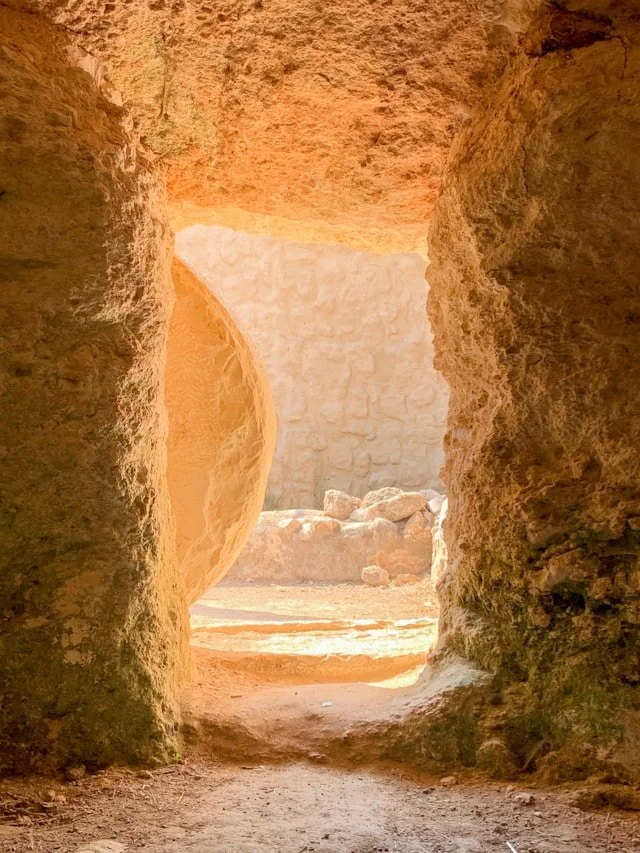
The stone is moved.
The promise has been kept.
There is so much in Matthew’s (28:1-10) account that we could sit with on any other day. The earthquake. The angel. The terror of the guards. The tenderness in the words, “Do not be afraid.” The women reaching for Jesus’ feet. The worship. The wonder. The fear and great joy somehow occupying the same body at the same time.
But today, above all, is a day to rejoice.
After the long ache of Thursday, Friday, and Saturday, Easter does not whisper. It announces. Jesus, who was crucified, is not here. He has been resurrected, just as He said.
Just as He said.
Those words feel especially tender to me this morning. Because after all the confusion, all the horror, all the silence, Easter reminds us that death does not get the final word. Darkness does not keep what belongs to God. Silence is not absence. The promises of Jesus do not expire in the tomb. He has been resurrected, just as He said.
And one of the details I love most in this passage is that Jesus does not first appear to the disciples, hiding away in their grief and confusion. He appears to the women.
The women who stayed.
The women who had remained near the cross.
The women who came to the tomb.
The women who, even in their sorrow, kept showing up.
The women who simply wanted to be near Jesus, even if all they could do was tend to the place where His body had been laid.
And it is to them that heaven opens the first commission of resurrection morning: Come and see. Then go and tell.
What a holy kindness.
What a holy disruption.
In a world shaped by religious hierarchy, social protocol, and all the assumptions about whose voice carried weight, Jesus once again overturns expectations. He entrusts the first resurrection announcement to women. Women whose testimony would not have held the same value in that culture. Women who were not centered by religious power. Women who loved Him enough to stay.
Isn’t that just like Jesus?
All through His life here on earth, He kept crossing the lines people thought He should respect. He kept seeing the people others overlooked. He kept honoring those who had been pushed to the edges. And in resurrection, He does it again. Even in triumph, Jesus is still turning the world right side up by the upside-down ways of the Kingdom.
And I cannot help but love that the invitation changes here.
For much of Holy Week, the call was to stay. To linger. To witness. To grieve. To wait. But Easter morning carries movement in it. The angel says, “Come and see the place where He lay. Then go quickly and tell.” Jesus says it too: “Do not be afraid. Go and tell My brothers.”
Come and see.
Go and tell.
That is the rhythm of Easter.
We are not asked to stay at an empty tomb forever. We are invited to behold it, to be undone by it, to worship the risen Christ, and then to carry the news. Resurrection is too alive to keep to ourselves. The good news is too good to remain locked inside our own private joy.
And yet, even in the going, I do not think Easter asks us to forget the staying that came before it.
Because it is the staying that gives the going its depth.
If we have not lingered at the table, we may miss the intimacy of His love.
If we have not stayed near the cross, we may cheapen the cost of grace.
If we have not endured the silence of Saturday, we may rush past the miracle of Sunday.
But if we have stayed…really stayed…then Easter morning does not become shallow happiness or sentimental celebration. It becomes what it truly is: the bursting forth of hope after all seemed lost. The vindication of Christ. The defeat of death. The impossible, glorious declaration that Love was not defeated at the cross, but was accomplishing something greater than anyone could yet see.
This is why the women leave the tomb with “fear and great joy.” Because resurrection is not tame. It is wondrous, and disruptive, and holy. It shakes the earth and reorders reality. It meets us in our sorrow and does not merely comfort us. It transforms the whole story.
And perhaps that is where Easter meets us too.
Not only as a day to wear bright colors and sing loudly, though by all means let us do that. (How loud does your Pastor sing ‘Up from the Grave He Arose’?) Not only as the happy ending to Holy Week, but as the beginning of a new creation reality breaking in. A reality where sin and death are not ultimate. A reality where grief is real, but not final. A reality where the worst thing is never the last thing for those held in Christ.
So today, I’ll rejoice.
Rejoice that the silence has been broken.
Rejoice that the promise has been kept.
Rejoice that the tomb is empty.
Rejoice that Jesus still meets the faithful in their grief and turns them toward hope.
Rejoice that the women who stayed became the first ones sent.
Rejoice that resurrection still breaks every category too small to contain the living Christ.
And then, having rejoiced, go.
Go and tell that death does not win.
Go and tell that Jesus is alive.
Go and tell that the cross was not the end of the story.
Go and tell that hope blooms even out of the darkest ground.
Go and tell that the One who was crucified has been raised, just as He said.
Because Easter morning is not only the Church’s celebration. It is the Church’s commission.
Come and see.
Go and tell.
Christ is risen.
He is risen indeed!
Photo by Pisit Heng on Unsplash