
The Long Light of Christmas - When the Light Does Not Leave (The Holy Innocents)
Today, the Church marks the Feast of the Holy Innocents.
It is not a day many of us know by name—perhaps because it interrupts the tone we prefer to keep this week. The carols have softened. The candles are still warm. We want the story to move forward, toward joy uninterrupted.
But the Church pauses us here, because Scripture does.
“When Herod saw that he had been tricked by the wise men, he was infuriated, and he sent and killed all the children in and around Bethlehem who were two years old or under…” Matthew 2:16
This is the part of the Christmas story we rarely read aloud. It's not pretty and sparkly like the other parts of the story.
The song stops.
The violence intrudes.
The story refuses to stay tidy.
Herod is afraid: not just of a child, but of what that child represents. A different kind of kingdom. A reign not built on fear, power, or control. And in his fear, he does what violent rulers have always done (and are still doing today): he protects himself at the expense of the vulnerable.
Children die.
Matthew does not soften this. Instead, he reaches back into Israel’s memory:
“A voice was heard in Ramah,
wailing and loud lamentation,
Rachel weeping for her children…”
— Matthew 2:18, quoting Jeremiah 31:15
Rachel weeps.
The mothers weep.
Scripture names it.
This matters.
Why does it matter, you might ask? Because the Bible does not rush grief out of the room to make space for celebration. It does not sanitize the cost of Incarnation. From the beginning, Jesus enters a world where children are not safe, where power kills, and where fear masquerades as authority.
The Light of the World, Jesus, is born into that world.
Jesus’ story begins with flight: his family escaping in the night, becoming refugees in Egypt. The long light of Christmas does not glow from a distance. It is not protected from danger. It is present in the terror, the chaos, and the carnage of the aftermath.
This is the cost of Incarnation:
God does not observe suffering from afar.
God absorbs it.
God enters it.
And still, we ask…because we are human:
If God is good, why does this happen?
Why doesn’t the light stop the storm?
Scripture does not give us a tidy answer. Instead, it gives us presence.
“The Lord is near to the brokenhearted,
and saves the crushed in spirit.”
— Psalm 34:18
Near.
Not explanatory.
Not hurried.
Near.
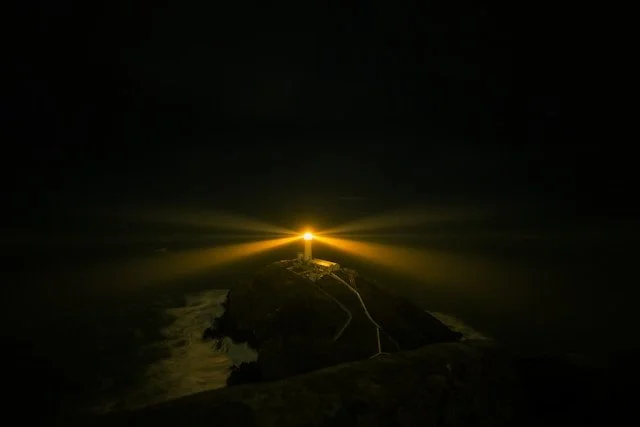
This is where the lighthouse image comes back to me.
The storm is real.
The waves are violent.
The light does not calm the sea.
But it does not turn off or go dim.
In fact, the light becomes even more visible because the sea is dangerous. It becomes the object of desperate focus. Its purpose is not to deny the storm, but to make a way through it; to orient, to guide, to say, “you are not alone out here.”
So many carry grief through Christmas. Death, sickness, and injury do not pause for holidays. Trauma does not wait for January. There are empty chairs at tables, names that ache to be spoken, memories that press in harder when the world insists we should be joyful.
The Church does not ask us to avoid or go around this.
The Feast of the Holy Innocents tells the truth: Christmas contains grief, and God does not avoid it.
The long light of Christmas does not promise safety from pain. It promises presence within it. It refuses to abandon us: not when we are numb, not when we are angry, not when we are too tired to hope.
This is Emmanuel.
God with us.
Here, too.
Even now.
And the Light does not leave.
Here’s the reality for me – this isn’t theoretical in my life, and my guess is, for many of you it isn’t as well. These are simply some words that I sit here and type out. This is lived experience. This is understanding that deep grief is a walking companion of mine. It is learning that I can choose to be angry and avoid all the pain and be miserable and hopeless (and I was for a moment), continuing to scream “WHY” at God. However, I have learned, very slowly, that God’s nearness has often come not with answers, but with staying, with leaning in, with drawing me closer even as I try to push him away.
There is no tidy way to wrap up this post. This post started with a history lesson and dove right into the ick! And yet, there is still Light. And I promise, this will have a beautiful outcome in the post on January 6th, Epiphany.
And…the Light is always shining!
Maybe you are sitting in a dark, stormy place. I get it. Might I offer you a simple practice as we walk through the next week or so of Christmastide? Perhaps something that will help you breathe a little easier and see the Light shining through the storm of your circumstances.
A Practice for the Long Light (Dec 28–Epiphany)
Practice: Stay with the Light
Once a day, at any point that feels natural, pause for one minute.
You do not need silence.
You do not need candles, journaling, or words.
Simply pause and slowly pray this prayer:
Emmanuel,
God with me.
Stay here.
I am not ready to move on yet.
That’s it.
If grief surfaces, do not push it away.
If nothing surfaces, do not force it.
The practice is not feeling something.
The practice is staying.
Some days, you may want to add:
“Be near to the brokenhearted.” (Psalm 34:18)
or simply: “You are here.”
This is a Christmastide practice because Christmas is not a moment to complete: it is a presence to inhabit.
Let the long light orient you.
Let it keep you company.
Let it stay on.
Photo by Mark mc neill on Unsplash