
Leading While Tender
There are seasons when leadership feels like carrying something fragile in your hands; something holy and tender, while also trying not to drop the million other things you’re supposed to be responsible for.
To be honest, when I read that and think about the reality of my life in this current season, that image is far too tidy.
This season doesn’t feel like carrying one delicate thing. It feels like carrying a stack of glass plates while someone keeps adding more: grief, responsibility, unanswered questions, other people’s needs, and the relentless noise of a world that can’t seem to stop shouting long enough to notice how much is breaking all around.
Usually, I can do a pretty decent job of compartmentalizing all of the complexities that need to be navigated with each scenario. I could place care for others and the empathy for that pain in one room, leadership in another, my own emotions for what I’m personally walking through in yet another, and keep moving. This past week, that system hasn’t simply fallen apart; it has disintegrated. Trying to rebuild it would be like building a sandcastle barely within reach of the waves – I just don’t know if I could rebuild it even if I tried.
But I’m also not sure I should.
Because maybe the ability to seal everything off isn’t strength. Maybe it’s just survival. And maybe God is inviting me into something truer now; something more integrated, more human, more dependent.
The tenderness has always come in waves: there is a mercy in that,
The first wave was losing our son, PJ, in 2017.
There is no handbook for how to keep showing up when your heart has been ripped open. There is no checklist for how to make decisions, care for people, speak kindly, lead meetings, or plan a future when the future you imagined has collapsed.
And yet, life keeps asking things of you. Work keeps coming. People keep needing. Ministry keeps moving. Grief of this type doesn’t just ‘run its course’ and disappear, and it certainly doesn’t pause the calendar for you to catch up.
Then came the second wave: my mom this past year.
That kind of loss does something different. It’s not only grief; it’s disorientation. It’s the feeling that a foundational layer of your world has shifted. It’s discovering that what you thought you had time to say, ask, understand, or settle… you don’t.
And now there is a third wave I didn’t anticipate: the reality of caring for my dad in ways I never expected. It was unexpected, partly because my mom didn’t want to burden me with what she was seeing. So now I’m stepping into a reality that feels both urgent and tender, because it’s love, and its responsibility, and it’s complex. It’s also a grief of its own: grieving what is changing while trying to honor what still is.
And that’s just a fraction of the personal side of this tenderness.
I look all around me and I see so many people carrying stories they never would have chosen.
A friend I love is walking through a rare, frightening illness in her husband: one of those situations where you can’t plan, can’t predict, can’t fix. You can only show up, hold hands, coordinate meals, send texts, make room for exhaustion, and pray when words run out. Those of us in her circle can’t take any of the pain away, or even take away the frenetic energy she is feeling when you are trying to desperately figure out the next step of care: for your loved one, your children, yourself. I know, I have been there. No one can carry that for you; it is a sense of urgency that only you can feel as it tears at the frayed edges of your heart and mind bit by bit.
And beyond the personal pain, there’s something in the air right now: something frayed and suspicious.
We’re walking carefully around each other because it feels like we don’t know who we can trust. Not because we’ve actually been harmed by the people standing next to us, but because public life and the current political air have trained us to believe that disagreement equals danger. We all look at anyone as a potential “other.” We carry this fear that the person across the table will become the ugliest version of what we’ve seen on a screen, no matter which “side” anyone falls on.
And the cost is real.
In some way, we have all lost a little bit of what it means to look at someone who believes differently than we do and see them as a precious and sacred life, created in the image of a loving God.
That sentence hurts to write. But I believe it’s true. And I believe it’s one of the most urgent spiritual crises we are facing right now.
My body is telling the truth that my mind is trying to manage. In this season, this space where my emotions can no longer be contained, sometimes all I can do is cry. I literally feel the tears behind my eyelids all the time. I want to fix it, to make it right. And the helplessness I feel is something I can sense in every muscle of my body.
Some days, it’s not even one specific thing: it’s the accumulation.
I hear rhetoric that takes me straight back to my high school years: fundamentalism, fear-based certainty, “us versus them” thinking, faith wrapped in power and identity, and anxiety. It crushes my lungs when I try to breathe through it. And it crushes my soul when I bring it to God.
It’s not just grief. It’s grief layered with disillusionment. It’s heartbreak over lives being senselessly taken. It’s fatigue from constant outrage. It’s the spiritual ache of watching people lose sight of what matters: and lose sight of the actual Way of Jesus.
And in the middle of it all, I’m still leading.
Still writing emails. Still planning gatherings. Still shepherding teams. Still showing up for people. Still trying to be steady when I feel anything but steady.
There’s a frenetic energy that rises in me, maybe in all of us, to fix things and make it right in this very moment. It is the same frenetic energy that was in the hospital room with PJ. That desperation to make things make sense – to make things right again.
To prove. To correct. To persuade. To solve. To control outcomes.
To be right.
But if I’m honest, “being right” can become a counterfeit comfort. Sometimes it’s just self-protection wearing shiny, religious clothing. A way to feel safe. A way to feel superior. A way to feel like we’re doing something, when what we really want is relief.
God knows our hearts. He knows what’s mixed and tangled in us. He knows how often our urgency is more about our own anxiety than anyone else’s good.
And still…He invites us closer, not cleaner.
When I’m teetering (this is my current status right now), when I feel like I’m standing at the edge of despair, I find myself reaching for the passages that remind me that God is not nervous. He is not panicking at all.
Daniel prays, “Blessed be the name of God forever and ever… He changes times and seasons; He removes kings and sets up kings” (Daniel 2:20–21).
That’s not a call to passivity. It’s a call to remember who is actually holding history (and future).
Psalm 2 paints the same picture: human beings raging, posturing, plotting, and God is not undone. “He who sits in the heavens laughs; the Lord holds them in derision” (Psalm 2:4). Not because suffering is funny, but because rebellion does not threaten Him.
I don’t read those verses as a shrug. I read them like someone grabbing a railing because the ground feels unsteady.
God’s sovereignty doesn’t erase grief. But it does give me, give us, somewhere to put it.
It reminds me that my job is not to carry the world on my shoulders. My job is to stay faithful in the square of ground I’ve been given. So what does it look like to lead while tender? And leading could be in your place of work, in your home, in your place of worship, or serving, or in all of those places.
Not perfectly. Not loudly. Not with performative certainty (which I have reminded myself is actually arrogant ignorance – and I don’t like that part of me, so I am going to try to move away from anything that could be mistaken for performative certainty). For me, it’s starting to remember what a covenant life with God looks like – not more religion (or performance), but a life shaped by the character of God. I want to have a walk that looks like Micah 6:8: “To act justly, to love mercy, and to walk humbly with your God.”
That verse is so familiar that we can accidentally turn it into a slogan. But in a season like this, it becomes painfully practical. To read and sit in this short verse in the context of the whole of Micah 6, and bring it into today, for me, this is what it looks like.
To act justly means I don’t let my fear make me cruel. It means I chose to tell the truth. I choose to protect what’s vulnerable. I refuse to treat people like problems to solve or obstacles to overcome. It means I start where I have actual responsibility and influence: my home, my church, my conversations, my leadership.
To love mercy means remembering that every person before me is a whole human being. Not a label. Not a talking point. Not a stereotype. Mercy looks like curiosity. It looks like patience. It looks like refusing to dehumanize: even when I feel defensive, even when I feel angry, even when I feel exhausted.
To walk humbly means I stop trying to be the savior. It means I admit my limits. It means repentance stays close. It means I can say, “I don’t know,” without falling apart. It means I seek peacemaking and reconciliation. It means I return to God again and again: not to win, not to perform, but to be formed.
And maybe this is the strangest part: leading while tender is not leadership’s death sentence. It might be the very place God meets us. Not because pain is good, but because God is near to the brokenhearted. Because dependence is not failure. Because softness can be strength when it’s rooted in Him.
Christ Have Mercy
God, I bring You the grief I can name and the grief I can’t.
I bring You my anger, my helplessness, my fatigue, and my longing for the world to be made right.
I confess how quickly I want to fix what only You can heal.
Put my heart in the posture to receive hope.
Make me faithful in my little corner of the world:
to act justly, love mercy, and walk humbly with You.
Teach me to see people as image-bearers again.
And teach me to lead like Jesus: steady, truthful, and full of love. Amen.
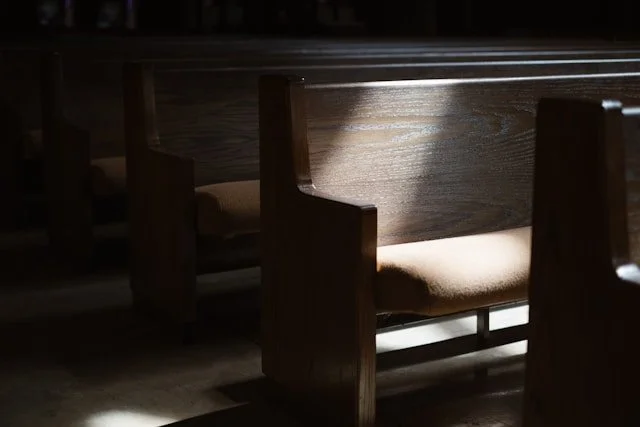
Photo by Branimir Balogović on Unsplash