Holy Week: Sitting with the Story
Every year, Holy Week arrives with an invitation I am not always eager to accept. I would often rather read a happy Psalm that makes me feel good, or plan all of the fun things for Easter day and give my best to my family for the celebration. I want to move quickly toward Sunday afternoon, post-church, because then I can avoid slowing down enough to sit and listen, once again, to the words of agony Jesus cried out on the cross. Or sit in the dirt at the foot of the cross with Mary in her own agony as she watches her son give everything for her…for me.
But Holy Week does not rush. It does not seem interested in my efficiency, my spiritual productivity, or my ability to package everything into a neat “carry-out” box. Instead, it asks me to enter the tension, the betrayal, the dirty feet, and the confusion of disciples trying to understand why their Lord would kneel to serve them. It asks me to stay with the misunderstanding, the fear, the weeping, and the silence. Holy Week asks me to sit and stay. To watch and weep. To grieve and to rejoice. To be uncomfortable in my comfort.
Maybe that is part of why this week can feel so uncomfortable. We are people who like things to be nice and tidy. Yes, we know the Easter story, but we do not want to get too close; with our pretty Easter outfits, our pretty flowers, our baskets full of chocolate, and our tables filled with abundance. Hands washed, prayers said, food eaten, and holiday over. Miss me with that dinner on Maundy Thursday, the violence of Good Friday, the panic of Silent Saturday. But bring on the pretty and neat things of Easter Sunday. We like clean and comfortable. We like to get to the grace and mercy and completion. But Holy Week asks us to stay close to the dirt, the tears, the pain, the comfort, and the incomplete.
Holy Week does not need your productivity. It asks for your presence, sitting with the story long enough for it to read you back.
I know how to do a lot of things, but I do not always know how to linger. I know how to read the story. I do not always know how to stay inside it. I am often tempted to treat Holy Week like a bridge to Easter instead of sacred ground in and of itself.
Holy Week is not only a story for me to understand. It is a story that helps me understand myself.
When I sit with these passages long enough, I begin to realize that I am not only reading them. They are forming and reforming me. They are bringing me back to a place, a space, to sit and breathe, even when it feels heavy to take a breath. Somewhere in the betrayal, the fear, the grief, the silence, and the staying, I begin to recognize myself in the story.
I may see myself in Peter because I have a deeply rooted need to control and to fix, because I do not want to feel what comes with pain and disappointment if I cannot hold everything together. I do not want to be a broken leader. I want to be a shiny, polished, dependable version of myself, the kind that never wavers, never trembles, never comes undone. But that version of me does not exist this side of heaven.
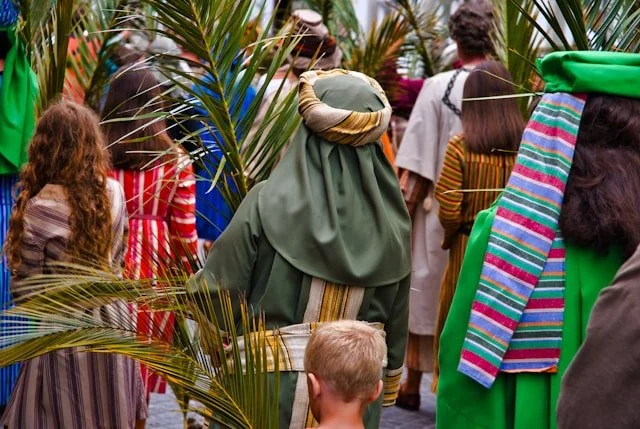
I may see myself in the crowd because I know how easy it is for fear to silence a voice. I can imagine myself wanting to disappear rather than be associated with suffering, wanting to turn away rather than remain present to agony. And if I am honest, I know how often I want to be near Jesus when the palms are waving and the cloaks are laid down, but not when the path turns toward dust, blood, and abandonment.
I may also see the beauty of the women who stayed, because there is a sacredness in the space of dying, one that feels thin and near to heaven. They were broken, emptied of tears, and still they remained. Anyone who has held the hand of someone slipping from this life into the next knows something of this mystery. It is unbearable sorrow and unspeakable splendor, somehow occupying the same space.
The closer I get to the cross, the harder it becomes to remain a detached observer. Holy Week reveals not only who Jesus is. It also reveals who I am, who I want to be, and the deep, wide canyon between the two, with Jesus as the only bridge.
And maybe that is part of what Palm Sunday exposes before we ever arrive at Good Friday. Palm Sunday is full of praise, but it is also full of misunderstanding. The people cry, “Hosanna,” and lay down branches before Jesus, but many are still hoping for a Savior who will overthrow Rome, restore order, and bring victory in a way they can recognize and celebrate. They are ready for glory. They are less ready for a cross.
If I am honest, I am not so different.
I want Jesus to be strong in all the ways I define strength. I want Him to fix, rescue, resolve, and vindicate. I want palms without passion, celebration without surrender, kingship without crucifixion. I want a faith that is beautiful and triumphant, but not one that asks me to kneel in the dust and stay awake in the garden or stand near the cross with no power to change what is happening.
Palm Sunday reminds me that it is possible to welcome Jesus and still misunderstand Him. It is possible to sing with the crowd and still reject the kind of King He is. He does not ride in on a warhorse, but on a donkey. He does not seize power as we would. He receives praise with full knowledge of the rejection that is coming. He enters Jerusalem not to avoid suffering, but to walk straight into it.
This is not weakness. This is the strange, upside-down strength of God.
It is the strength to be misunderstood and keep going.
The strength to be betrayed and keep loving.
The strength to wash dirty feet.
The strength to remain silent before false accusation.
The strength to entrust Himself fully to the Father.
Isaiah had already given us language for this kind of Savior. Not the conquering figure we might have scripted for ourselves, but a man of sorrows, acquainted with grief. One who would be despised and rejected. One who would carry what was not His to carry. And Psalm 22 refuses to let suffering stay abstract or polished. It gives us words for anguish, abandonment, mockery, and pain. Holy Week does not flatten grief or tidy up sorrow. It tells the truth about both. It reminds us that Jesus did not save from a safe distance. He entered fully into the deepest places of human suffering and carried them in His own body.
And that kind of kingship is harder for me to receive than I want to admit.
Because I still want a manageable Jesus. A useful Jesus. A Jesus who fits neatly into my plans (and my pretty planner), my aesthetics, my timelines, my preferred outcomes. But Holy Week will not let me keep Him there. It confronts me with the Lord who comes low, comes near, comes weeping, comes serving, comes suffering, and comes loving all the way to the end.
Serving in the evangelical world, I feel some grief here, too. I think many of us have been taught how to celebrate Easter Sunday, but not always how to inhabit the road that leads there. In our suspicion of liturgy, tradition, and anything that felt too formal or too high church, I think we may have lost some of the beauty of Holy Week. Not the truth of it, necessarily, but some of the texture. Some of the reverence. Some of the slowness. Some of the embodied practices that help us not only remember the story but also enter it.
And perhaps that loss has left us more comfortable with polished celebration than with sacred discomfort.
Maybe that is why Palm Sunday matters so much. It stands at the door and asks us what kind of King we are welcoming. Not just whether we will sing, but whether we will stay. Not just whether we will wave palms, but whether we will follow Him when the crowd thins and the mood changes and the road narrows into suffering.
I don’t want to rush past this entrance.
I want to let Palm Sunday interrupt my desire for tidy faith.
May we let the branches in our hands become something more than decoration. May they become a confession that we, too, are prone to praise Jesus for what we hope He will do, while resisting what He has actually come to do in us.
This week, perhaps the invitation is simple, though not easy. Slow down. Read the story again. Sit with the discomfort. Let the King on the donkey unsettle your assumptions. Let the tears, the dirt, the table, the garden, the trial, the cross, and the silence do their work on you.
Do not rush to Sunday afternoon just yet.
Stay with Him in the city.
Stay with Him at the dirty feet
Stay with Him at the table.
Stay with Him in the garden.
Stay with Him at the cross.
Stay with Him in the silence.
And when you arrive at the cross, listen again to His final surrender: “Father, into your hands I commit my spirit.” Even there, in agony and abandonment, Jesus entrusts Himself fully to the Father. Not resignation, but trust. Not defeat, but surrender. The final movement of Holy Week is not frantic grasping, but yielding. And perhaps that is part of the invitation for us too. In our own grief, fear, uncertainty, and exhaustion, we are invited to place ourselves again into the hands of God.
Because Holy Week does not need your productivity. It asks for your presence.
And maybe, if we stay with the story long enough, we will find that it is not only telling us who Jesus is. It is teaching us how to recognize Him. Not only in the triumph of resurrection morning, but in the humility, surrender, and costly love that lead us there.
Photo by Brady Leavell on Unsplash