
Stay at the Cross (Good Friday)
Good Friday does not seem to be a day the church wants to linger in.
We make the clean graphics for our social media pages and say, “Friday is here, but Sunday’s coming.” We rush to reassure. We rush to resolve. In many evangelical spaces, it is still not all that common to have a Good Friday service, much less to step into any liturgy or rhythm that lets the solemnity of the day settle on us. We move quickly. We nod toward the cross, maybe sing a song or two, and then start inching our hearts toward resurrection before we have really stopped to see what Love was willing to bear.
We rush past Good Friday.
But then again, we rush past death, too.
Especially horrific death. Especially death that is bloody and impossible to dress up. We do not know what to do with open wounds, with labored breath, with blood, with the unbearable reality of watching a body give way. It is too much. It is too exposed. It confronts us with our helplessness, and we do not like to be helpless. We want to fix, explain, organize, clean up, make meaning too quickly. We want to move on before the weight of it has fully landed.
Good Friday won’t let us do that.
Good Friday does not ask us to explain the cross too quickly. It asks us to stand near enough to remember what Love was willing to bear.
That is part of why it is such a hard day to stay with. The cross is not tidy. It is not symbolic in some abstract, sanitized way. It is not simply doctrine to affirm with our mouths while keeping our hearts at a safe distance. It is suffering to witness. It is mockery and violence and shame. It is abandonment, thirst, grief, blood, splinters, cries, and the slow unmaking of a human body. It is the Son of God hanging in full view of the world He came to save.
And honestly, there is something in me that still wants to look away.
Not because I do not love Jesus. Not because I do not believe the cross matters. But because to stay at the foot of the cross is to let myself be confronted by the cost of Love. It is to see that salvation was not cheap. Grace was never flimsy. Mercy was never soft in the way we often mean soft. The love of God is tender, yes, but it is not delicate. It is strong enough to remain. Strong enough to absorb violence without becoming violence. Strong enough to endure what I would run from.
Good Friday slows us down enough to see what we often say we believe but rarely stop to behold: the love of God is not abstract. It has wounds. The love of God is embodied in Christ.
Isaiah called Him a man of sorrows, acquainted with grief. Psalm 22 gave words to anguish, abandonment, and mockery long before Jesus took them on His own lips. And there on the cross, those ancient words became flesh, and breath, and blood. This is not a God who saves from a distance. This is not a Savior untouched by human suffering. This is Jesus entering fully into shame, pain, and the terrible loneliness of death.
He bears it openly.
He bears it publicly.
He bears it in a body.
And that matters.
Because there is something profoundly holy about staying near a death you cannot stop. Anyone who has sat at a bedside, in a hospital room, in hospice, or in that long and terrible place where love is still present but fixing is no longer possible knows this. There is a sacredness there that is hard to describe. You teeter between wanting to vomit rage at God, wanting to gather your loved one up and carry them out of the suffering, and wanting to hold them so tightly that maybe your love could somehow keep them here and heal them. It is too much for the body. Too much for the mind. Too much for the heart.
And yet even there, there is holiness.
It is a sacred place to be in the space where death is near, where the veil between heaven and earth feels whisper-thin. Not because death is good. Death is awful. Death is violent in its own way, even when it comes softly. It tears and takes and leaves us undone. But the space near death, the place where our helplessness is exposed and our illusions of control fall apart, can become holy because it is there that we are brought face-to-face with love that cannot fix yet refuses to leave.
That is part of what the women teach us on Good Friday.
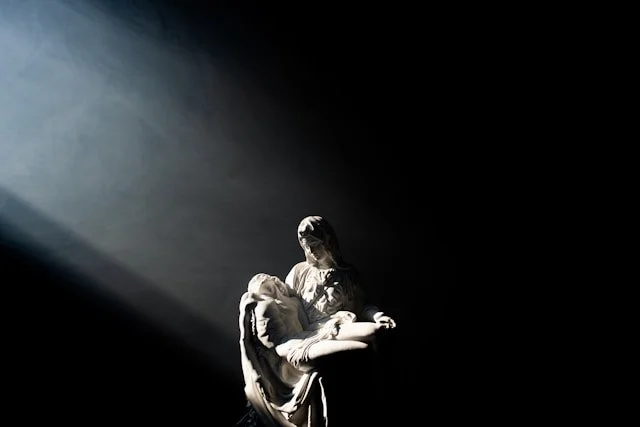
Mary, Mary Magdalene, the others, John — they stayed. They did not save Him. They could not stop what was happening. They could not pull Him down from the cross or close His wounds or change the ending of that day. But they remained near. They bore witness. They stood in the unbearable place and did not turn away.
There is something deeply sacred in that kind of staying.
Not loud. Not triumphant. Not useful in the way we often measure usefulness. Just faithful presence.
I think that is part of the invitation of Good Friday for us too. Not to solve the mystery. Not to rush to Easter language before the sun has even set. Not to tidy up the brutality of the cross with polished phrases and pretty images. But to stay. To let the horror be horrifying. To let the sorrow be sorrowful. To let the cross be what it is: the place where Love was poured out in full, where Jesus bore abandonment, mockery, violence, and shame so that nothing in our own suffering would ever be beyond His knowing.
Some of the holiest things we can do are simply to remain near.
To stay with the grieving.
To sit in the room when words fail.
To hold a hand.
To keep watch.
To love without being able to fix.
Good Friday reveals that kind of love in its deepest form. Jesus does not turn away from suffering. He does not escape it. He enters it and remains. Even in the cry of forsakenness, even in thirst, even in the darkness that falls over the land, He stays.
Love stays.
And that means the cross is not only the place where my sin is dealt with, though it is that. It is also the place where the love of God is revealed in a way that strips me bare. I cannot stand at the cross and keep pretending love is shallow. I cannot stand there and imagine grace as cheap. I cannot stand there and believe Jesus only loves from a distance.
He loved to the end.
He loved in the open.
He loved with wounds.
Maybe that is why Good Friday is so hard for the modern church, and for modern people in general. We want the benefits of the cross without looking at its cost. We want resurrection without reckoning. We want a faith that is comforting, but not one that asks us to stay in the presence of suffering long enough to be changed by it.
But Good Friday asks us not to look away.
It asks us to stand near enough to remember what love was willing to bear.
It asks us to let the cross confront our instinct to rush, to fix, to explain, to escape.
It asks us to remain at the foot of the cross with open hands and no cleverness left.
And maybe that is where the deepest knowing begins. Not in mastering the cross, but in being mastered by it. Not in solving it, but in standing beneath it long enough for its love to undo us.
So today, stay at the cross.
Stay when it feels uncomfortable.
Stay when it feels too heavy.
Stay when you want to rush to Sunday.
Stay when you have no words.
Stay when all you can do is watch and weep.
Because Good Friday does not ask for polished explanations.
It asks for witness.
It asks for reverence.
It asks for presence.
And in that whisper-thin place, where death is near, and love does not turn away, we begin to see that the cross is not only where Jesus died. It is where love refused to leave.
Photo by Grant Whitty on Unsplash