Beauty In the Bruise
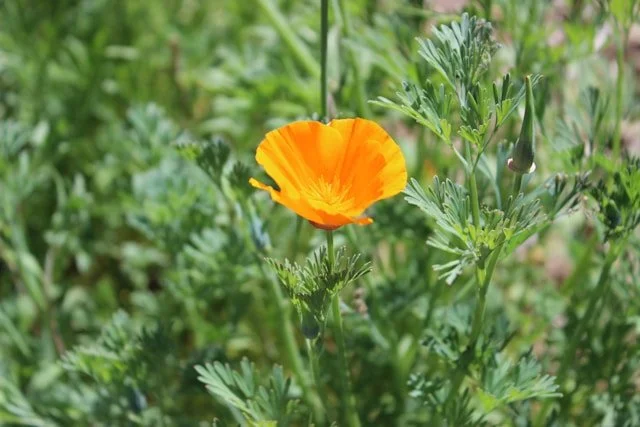
This spring, the desert has just wrapped up being covered in poppies. Bright orange blooms were scattered across the rocky ground like someone spilled joy in the middle of all this dust. They are delicate and stubborn at the same time, which feels very on-brand for the desert: thin petals, wild stems, beauty growing in a place that does not often make beauty easy.
The other day, I noticed one of those poppies, that had been doing its best to hang on into the summer heat, lying on my driveway. It had been knocked loose from the main plant, separated from its roots, no longer standing in the little patch of desert soil where it had first opened itself to the sun. It was just there, on the concrete, clearly stepped on. The petals were bent. Some were creased. Some carried the unmistakable impression of a shoe pressed into them.
It was, by every reasonable definition, crushed.
And still, I couldn’t stop looking at it.
Because in the creases, the way the morning sun was hitting it, there was color I might not have seen otherwise. Where the petals had bent, a bluish shadow had appeared, almost like bruising. Where the shoe had pressed into the orange, there was this sheer, luminous quality to the color. It was not untouched beauty. Not perfect beauty. Not the beauty of a flower still waving in the desert wind as if nothing had ever happened to it. But it was beauty still. Painfully beautiful, really. The kind of beauty you almost feel guilty noticing because you know it came through damage.
Isn’t that so much of life?
There are places in us that have been stepped on. Places where life left a mark. Places where grief pressed down hard. Places where disappointment, shame, sickness, betrayal, fear, regret, trauma, or loss left an impression we could not smooth back out no matter how much we tried. And we are so quick to believe those crushed places are the end of the story.
We tend to think beauty belongs to the untouched parts of us. The strong parts. The parts that still look attached to the stem, standing tall, blooming properly, doing what flowers are supposed to do. But maybe there is a kind of beauty God reveals in us even after the crushing.
Not because the crushing was good.
Not because the shoe print was holy.
Not because loss is secretly a gift if we just learn to look at it correctly.
No. Some things are just painful. Some things should not have happened. Some losses are losses all the way down. Some griefs do not become less grievous because we found a metaphor in the driveway.
But still, even there, beauty remained.
Recently, I spent five days in the second part of a soul care experience. And when I say five days, I mean five intensive days that began at 7:30 in the morning and went until 5:00 in the evening. The first part happened a few years ago, and it invited us to walk back through our stories. We examined deep wounds, core longings that had gone unmet, and the unhealthy coping or escape strategies that developed along the way. It was like drinking the lessons of multiple therapy sessions through a firehose.
This second part was similar in some ways. We revisited our stories. We examined those unhealthy strategies again. But this time, we also received and offered soul care to one another. I was not prepared for the deeper dive into my own story, for the layers that had surfaced since the last session, or for the emotional weight of seeing something new in myself and then turning around to walk gently with another person as they processed their own new revelations. If part one was like drinking from a firehose, this part was like trying to get a sip under Niagara Falls.
There is a kind of holy exhaustion that comes when God begins touching places you have learned how to work around. Not ignore exactly. Not deny. Just manage. We become very skilled at managing the crushed places. We learn how to function around them, serve around them, laugh around them, lead around them, write around them, love around them. Sometimes we even theologize around them.
But healing asks different things of us. Healing asks us to look. To tell the truth. To notice the places where something pressed down hard and left a mark. To name the crease. To acknowledge the bruise. To stop pretending the shoe print is not there.
And here is the mercy I’m still learning: God doesn’t look at the crushed places in us with disgust. He doesn’t turn away from the bruised petals. He doesn’t shame us for the marks we carry. He comes near. He sees what is true. And somehow, in ways I don’t fully understand, He brings beauty even there.
Again, not because the crushing was good.
But because He is.
Scripture tells us that Jesus was “a man of suffering who knew what sickness was” and that He was “pierced because of our rebellion, crushed because of our iniquities” (Isaiah 53:3, 5). Jesus was not untouched by pain. He did not float above suffering with a serene smile and a neatly packaged explanation. He entered it. He bore it. He carried it in His own body. And somehow, in the mystery of God, the worst crushing the world has ever done became the place where redemption bloomed.
The cross does not tell us suffering is lovely. The cross tells us suffering is not wasted in the hands of God. It tells us death does not get the final word. It tells us that what looks broken, finished, and defeated may still be held inside a story we cannot yet see in full.
Maybe that is what I needed the poppy to preach to me. I don’t have to be uncrushed to still carry beauty. I don’t have to pretend the bruising is not there. I don’t have to press the petals flat and make them look untouched. I don’t have to rush to resurrection language before I have told the truth about the shoe print. But I also don’t have to believe the crushing has erased what God placed in me.
There may still be color in the creases. There may still be light catching in the places I thought were only damaged. There may still be something of God’s glory shimmering through the very parts of me I have been tempted to hide.
And maybe that is part of what becoming means. Not becoming untouched. Not becoming impressive. Not becoming the version of ourselves who finally has no wounds, no questions, no grief, no unfinished places. But becoming more whole in Christ. More honest. More surrendered. More able to receive the love of God in the very places we once believed made us unlovable.
Over the next several weeks, I want to walk with some companions who have helped me think about this kind of becoming. Some of them are ancient voices from church history: Augustine, Julian of Norwich, Macrina, Brother Lawrence, Teresa of Ávila, Catherine of Siena, Basil the Great, Perpetua, and Athanasius. They lived in different centuries, different places, and different circumstances. Some wrote theology. Some prayed from sickbeds. Some led with courage. Some found God in kitchens. Some faced grief, fear, longing, obscurity, and suffering in ways that still speak.
They are not dusty museum pieces or names for seminary flashcards. They are companions. Witnesses. Mothers and fathers, brothers and sisters, who remind us that we are not the first ones to walk this road. They remind us that God has always been forming His people in wilderness, grief, calling, courage, service, ordinary faithfulness, and hope.
Augustine will walk with us through restlessness and holy longing. Julian will teach us how to hope without pretending. Macrina will meet us near the edge of goodbye with resurrection courage. Brother Lawrence will invite us to find God in the ordinary, even in the reheated coffee and unfinished lists. Teresa will remind us that prayer becomes embodied in hands, feet, welcome, and service. Catherine will challenge the lie that humility means hiding. Basil will call us toward generosity that becomes visible. Perpetua will remind us that fear may be loud, but Christ is Lord. Athanasius will help us see that God is not merely helping us cope. He is making us whole.
Maybe together, their stories will help us see our own with a little more courage. Maybe they will help us notice the beauty God is still bringing forth, even in the creases. At least that is what they are doing or me – and I hope they will for you as well.
That little desert poppy was dying. There is no way around that. It had been separated from its source of life. Its petals would not last much longer on the hot concrete. By the next day, it would probably be gone. But even at the end, even crushed, even marked by what had happened to it, it was still bearing witness. Still beautiful. Still telling the truth about the One who made it.
And maybe, by God’s mercy, so are we.
Maybe even in the crushing, there is beauty.
Not because pain gets to define us.
But because God does.
You might also like other posts from this series:
Intro: Beauty in the Bruise
Part 1: When Restlessness is Really Homesickness
Part 2: All Shall Be Well: Even Here
Part 3: Shaken But Not Overcome
Part 4: Prayers From the Edge of Goodbye
Part 5: The Greening Grace of God
Part 6: God In the Reheated Coffee
Part 7: The Holy Work of Hello
Part 8: When Humility Stops Hiding
Part 9: When Fear Is Loud But Jesus Is Lord
Part 10: The Long Mercy of Formation
Photo by Robyn Louise on Unsplash