The Greening Grace of God
We’ve reached the halfway point of this series, and without looking ahead, I can already tell you that Hildegard of Bingen is my favorite companion. I love her so much that I wrote my final paper for Church History about her. The more I learned, the more I found myself wanting to sit across a table from her, preferably somewhere near a garden, and ask her a thousand questions.
Hildegard embodied what I think of as a whole-life/whole-body believer. She didn’t seem to divide her faith into neat little categories where prayer belonged over here, work belonged over there, and creativity was something pleasant but spiritually unnecessary. She saw Father, Son, and Holy Spirit in Scripture, prayer, music, medicine, gardening, writing, art, study, leadership, and the courage to call wayward leaders back to faithfulness. All of it belonged to God, and all of it became part of her formation into humility, obedience, and a heart slowly being made cruciform.
I met Hildegard during a semester when I was feeling all the feelings. Imposter syndrome was running rampant. I was afraid I’d misunderstood God’s call to return to school, convinced I was too old to be there, and regularly wondering whether I was actually capable of doing the work in front of me. Most days, it felt less like I was growing and more like I was slogging through a muddy swamp, trying to keep my head above water while everything clung to me.
There was a point in that semester when I wondered whether I was growing spiritually at all or whether I was simply going through the motions. I was reading, writing papers, attending class, studying theology, and still feeling stuck. From the outside, it might have looked like growth. From inside my own heart, it felt like mud.
It took me half the semester to recognize that grief had quietly joined me once again. This time in the classroom.
Part of the reason I went back to school was PJ. He’d always told me I should go, and I’d always told him I was too old. Now I was finally doing the thing he believed I could do, and he wasn’t here to hear about it. I wanted to tell him what I was learning, argue through an idea with him, send him a photo of a grade I was proud of, or hear him remind me that he’d told me so.
This was grief for what could have been, and I hadn’t seen it coming. I can anticipate some of those moments, especially the large milestones in our grandson’s life when PJ’s absence will be unmistakable. But grief doesn’t send an itinerary. Sometimes it arrives years later and sits down beside us in a classroom, at a dinner table, during a celebration, or in the middle of something we thought would only feel joyful.
Then Hildegard came walking into my swamp with a word for the life of God that was already moving beneath the surface.
The greening of God.
Hildegard was born in 1098 in what is now Germany. She became a Benedictine abbess, theologian, visionary, composer, poet, preacher, correspondent, and student of the natural world around her. She wrote about theology and spiritual formation, composed liturgical music, created one of the earliest surviving morality plays, studied plants and remedies, founded communities of women, corresponded with popes and emperors, and confronted corruption within the church.
She was not formally educated in all the subjects available to educated men of her time, and yet she became one of the most remarkable theological voices of the medieval church. Leaders sought her counsel, while others received letters calling them to repentance and integrity. In a world that gave women very little public authority, Hildegard wrote, taught, preached, created, led, and refused to make herself small in order to make powerful men more comfortable.
What I appreciate most about her isn’t simply the long list of things she accomplished. It’s the way she understood them as belonging together. Her study of creation wasn’t separate from her worship. Her music wasn’t separate from her theology. Her care for the body wasn’t separate from her care for the soul. Her contemplation didn’t keep her quiet when leaders were harming the church.
Hildegard didn’t seem to experience God as flat, gray, or merely theoretical. God’s life was radiant, alive, creating, singing, healing, and growing. Her theology had dirt under its fingernails and music in its lungs.
One of the words most often associated with Hildegard is ‘viriditas.’ It can be translated as greenness, freshness, vitality, or greening power. For Hildegard, it described the life-giving vitality of God flowing through creation and, by grace, through the human soul. It was more than the color green. It was the living energy of God that causes what is dry to flourish and what feels depleted to become alive again.
Hildegard called attention to the greening life of God at work in creation, in the soul, and in the places we thought had gone barren.
Scripture is filled with this kind of greening. God brings gardens out of wilderness, rivers out of rock, life out of graves, and hope out of places people have already declared finished. Isaiah gives us this picture:
“The wilderness and the dry land will be glad;
the desert will rejoice and blossom like a wildflower.
It will blossom abundantly
and will also rejoice with joy and singing.
The glory of Lebanon will be given to it,
the splendor of Carmel and Sharon.
They will see the glory of the Lord,
the splendor of our God.” Isaiah 35:1–2
The wilderness doesn’t stop being a wilderness before God begins His work. The dry land doesn’t have to make itself fertile first. The desert blossoms because the life of God comes to it.
Goodness! I need that reminder every minute of most days, because greening grace is not the same as pretending the barren places were never barren. It doesn’t ask us to rename grief as gratitude before we’re ready or paint something pretty over what has been painful.
Resurrection doesn’t deny death. It declares that death doesn’t get the final word.
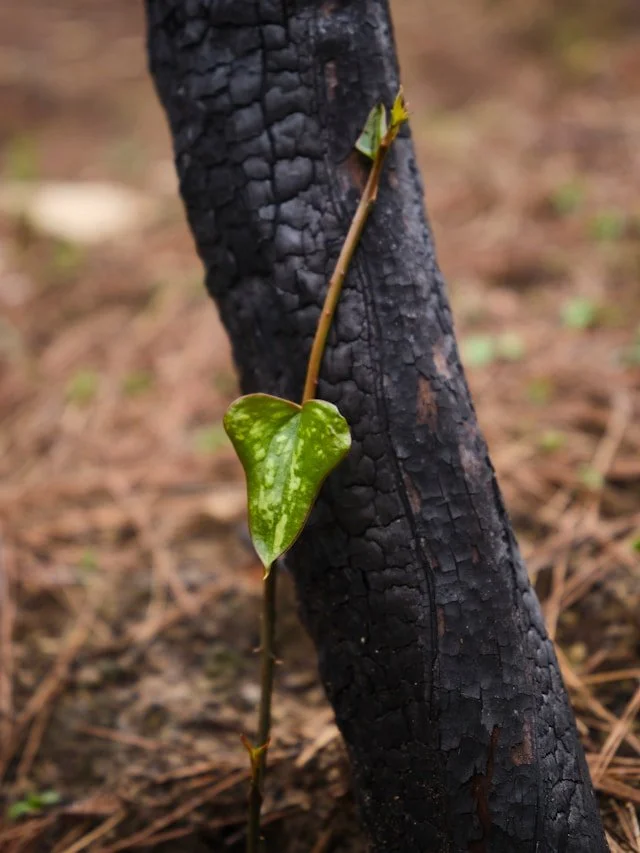
There are beautiful things that grow in muck. Lotus flowers and water lilies rise from muddy water. Some pine trees release their seeds in response to intense heat. Seeds split open in darkness before anything green appears above the soil. What looks like breaking may also be the beginning of becoming.
I couldn’t see growth during that difficult semester because I was looking for leaves when God was tending roots. I thought spiritual growth should feel strong, clear, and certain. Instead, it looked like continuing to show up while grieving, asking for help, writing one more page, and letting what I was learning move slowly from my mind into my life.
God used Hildegard to help me recognize that studying could be prayerful, creativity could be formative, questions could be faithful, and paying attention to the created world could teach me something about its Creator. She reminded me that God wasn’t only forming me during the moments that felt overtly spiritual. He was present in the research, the reading, the frustration, the beauty, the tears, and the stubborn decision to continue.
Jesus used the language of living things when He described our life with Him:
“Remain in me, and I in you. Just as a branch is unable to produce fruit by itself unless it remains on the vine, neither can you unless you remain in me. I am the vine; you are the branches. The one who remains in me and I in him produces much fruit, because you can do nothing without me.” John 15:4–5
Remaining isn’t flashy. Most of the time, we can’t see the life moving from the vine into the branch. We only notice later that a bud has appeared, a leaf has opened, or fruit has begun to form. This is one of the hardest truths for those of us who want reassurance that we’re growing. We’d like measurable progress, a spiritual report card, or at least a little sign that all this remaining is doing something. But the greening life of God often works quietly, under soil, under grief, under exhaustion, and under the ache of becoming.
Sometimes that greening comes through Scripture or prayer. Sometimes it comes through music, beauty, study, or the work of our hands. Sometimes it comes through another person who speaks life into us, calls at just the right moment, or sits beside us without expecting us to hold a conversation or make our emotions pretty for them. They see us, know us, love us, and stay.
They become, in that moment, one of the ways God keeps us connected to the vine.
Psalm 1 gives us another picture of a life slowly sustained by what is living:
“How happy is the one who does not
walk in the advice of the wicked
or stand in the pathway with sinners
or sit in the company of mockers!
Instead, his delight is in the Lord’s instruction,
and he meditates on it day and night.
He is like a tree planted beside flowing streams
that bears its fruit in its season,
and its leaf does not wither.
Whatever he does prospers.” Psalm 1:1–3
The tree bears fruit in its season, not every season. That feels important. There are seasons for visible fruit, and there are seasons when the holiest work happening in us is the deepening of roots.
Hildegard’s life reminds me that spiritual formation doesn’t happen in only one part of us. God greens the intellect and imagination, the body and soul, our courage and compassion, our work and worship. A song can wake up something. A garden can teach us to notice. Study can strengthen our love for God. Rest can return moisture to places in us that have become brittle. Speaking truth can be an act of devotion.
The question may not be, “Am I producing enough?” It may be, “Am I remaining near the source of life?”
The barren place may not be as dead as it looks. God’s life often begins quietly, long before we have language for what is happening. What feels hidden may still be growing. Maybe you, too, are in a season where you need the reminder that God is tending to the greening of your life.
This week, look for one small sign of life. It might be laughter returning, curiosity stirring, the desire to create something, the ability to rest without guilt, or the courage to tell the truth about how you’re doing. Don’t dismiss it because it seems small. New growth usually is.
Name the place that feels dry, barren, or done. You don’t have to force it to bloom, but you can bring it honestly into the presence of God. Ask yourself what remaining might look like there, what is God’s invitation to us there? Perhaps that is opening Scripture, taking a walk, making the appointment, receiving help, or letting someone sit with you in the silence.
Pay attention to what makes you feel more awake to God. Notice the song, beauty, prayer, work, conversation, or creative act that brings a little color back into your life. Hildegard’s witness reminds us that these things aren’t distractions from spiritual formation. They may be some of the very places where it’s happening.
Finally, keep watch for the people through whom greening grace arrives. Receive the phone call, the meal, the quiet presence, and the reminder that you’re loved without having to perform ‘wellness’ for anyone. Then, when you’re able, become that kind of presence for someone else.
The greening may be happening more slowly than you’d like and more quietly than you can see. But beneath the mud, beneath the grief, and beneath the unfinished parts of your becoming, the life of God is still at work.
You might also like other posts from this series:
Intro: Beauty in the Bruise
Part 1: When Restlessness is Really Homesickness
Part 2: All Shall Be Well: Even Here
Part 3: Shaken But Not Overcome
Part 4: Prayers From the Edge of Goodbye
Part 5: The Greening Grace of God
Part 6: God In the Reheated Coffee
Part 7: The Holy Work of Hello
Part 8: When Humility Stops Hiding
Part 9: When Fear Is Loud But Jesus Is Lord
Part 10: The Long Mercy of Formation
Photo by engin akyurt on Unsplash