When Fear Is Loud, But Christ Is Lord
I didn’t know anything about Perpetua until I took Church History.
And technically, I don’t remember anyone actually teaching me about her there either. I found her the way I found several of the women who have become companions for me in this series. I was researching something else, stumbled across her name, opened another tab, followed another footnote, and wandered happily down one of my many church history rabbit trails.
Except this one didn’t feel particularly happy for very long.
The more I read about Perpetua, the more unsettled I became. Even now, I can remember some of those reading sessions and how I felt in my body. It took me a while to understand why her story was affecting me so physically, but eventually I realized it wasn’t only the cruelty of what happened to her.
It was the fear.
I kept thinking about how afraid she must have been.
Perpetua was a young woman, probably around twenty-two years old, living in Carthage in North Africa in the early third century. She came from a prominent family, had recently become a Christian, and was the mother of a nursing baby (and probably a widow already). She was arrested with several other Christians who were preparing for baptism during a season of persecution under Emperor Septimius Severus (what a name – reminds me of the movie line: “My name is Maximus Decimus Meridius…”).
What makes her story especially remarkable is that portions of The Passion of Saints Perpetua and Felicitas are believed to preserve Perpetua’s own account of her imprisonment. We aren’t simply reading someone centuries later telling us that she was courageous. In parts of the story, we hear something much closer to her own voice.
And one of the first things we hear is the voice of her father begging her to live.
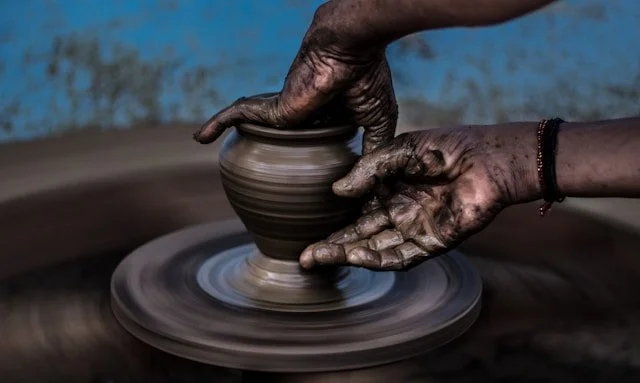
He came to the prison pleading with her to deny that she was a Christian. Perpetua pointed to an ordinary vessel nearby and asked whether it could be called anything other than what it was.
No, he told her.
Neither could she, she said.
She was a Christian.
Later her father came again, this time pleading with her to think of him, her family, and especially her baby. When Perpetua was finally brought before the governor, her father appeared carrying her child. Both he and the governor begged her to make the required sacrifice for the emperor.
Just do this one thing.
Just say the words.
Just perform the sacrifice.
Go home to your baby.
And Perpetua wouldn’t.
When she was asked directly, “Are you a Christian?” she answered simply, “Yes I am.”
I’ve wondered how her heart must have been pounding when she said it. Maybe that’s because I know something about the way fear can take over a body.
I’ve had a knife held to my throat before while someone whispered in my ear, “Don’t scream or it will be worse than you think.”
There really isn’t language for the fear of unknown violence. There is only the experience of it. Your body feels it everywhere. Your mind narrows into survival. Your blood seems to rush so quickly that you can barely hear anything except your own heartbeat pounding in your ears. And the strangest thing about that kind of fear is that sometimes your body remembers long after the danger is gone.
Decades later, it might be something small and seemingly unrelated. For me, sometimes it’s the smell of rain coming across the desert (maybe there is a blessing in having lost my sense of smell from Covid 5 years ago). Other times the connection is more obvious. I don’t like knives, especially hunting knives, and I have a very good reason for that.
The body remembers things the calendar says happened a long time ago.
In the moment when that fear became part of my story, I wasn’t consciously thinking about Jesus. I wasn’t quoting Scripture. I wasn’t creating a beautiful theological framework for suffering. I was surviving.
And I’m not going to take my younger, baby-believer self to task for that. I also won’t pretend any of us knows exactly what we would do in any terrifying moment until we find ourselves inside of it. I pray most of us never have to find out.
Maybe that’s one reason Perpetua undoes me. She knew something terrible was coming. She knew enough to be afraid. She had sat in a hot, crowded prison separated from the baby she was still nursing. She had watched her father beg for her life. She had heard the sentence pronounced. And still, somehow, she kept returning to who she was and whose she was.
This is where I think we can misunderstand the martyrs if we aren’t careful. We can turn them into Christian superheroes who didn’t experience fear the way ordinary people do. Their stories become tales of impossible spiritual bravery, and then we quietly wonder whether our faith is deficient because we tremble when life hurts.
But Perpetua doesn’t need to have been fearless for her witness to be courageous.
Courage is only courage because fear is present.
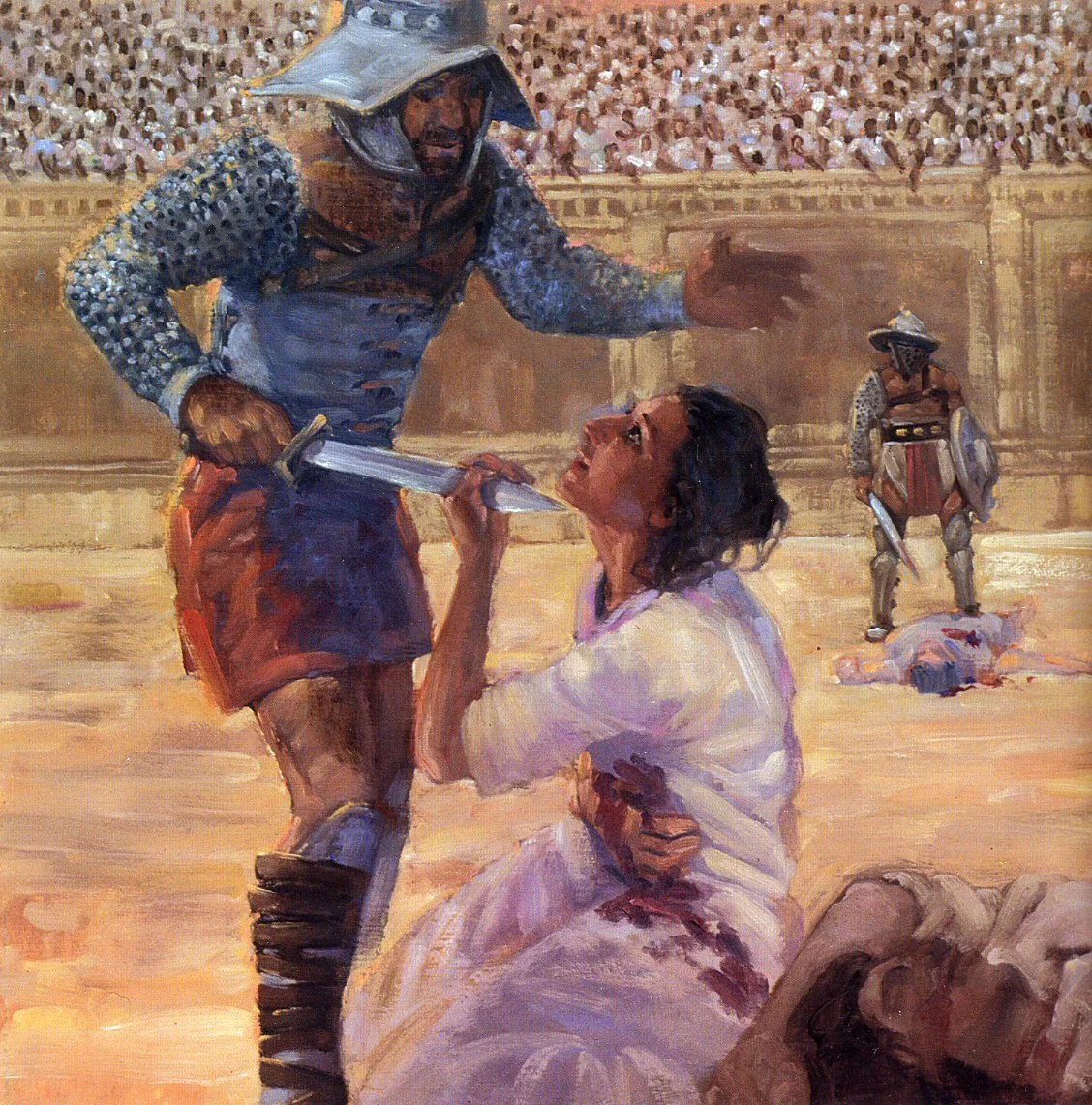
Eventually Perpetua and her companions were taken into the arena. The details are difficult to read. Perpetua and Felicitas, another young Christian woman who had given birth only days earlier, were attacked by a wild heifer. Perpetua was thrown violently to the ground. Yet when she got back up, one of the first things she did was go to Felicitas and help her. They survived the first assault only to be brought back into the arena and killed by the sword.
It’s an almost incomprehensible ending to the life of a twenty-two-year-old mother. And yet the story that remains isn’t really about Rome. Rome had all the visible power.
The prison. The governor. The soldiers. The arena. The animals. The sword.
Perpetua had almost none.
But Rome could threaten her body and still couldn’t tell her who she was. That may be the part of her story I need most.
Fear is loud. It’s also convincing.
Fear tells us that because something terrible could happen, we need to live as though it already has. It tells us that because we’ve experienced pain before, pain gets to determine what we do next. Sometimes fear speaks through our thoughts, and sometimes our bodies speak it before our minds have caught up.
That doesn’t make us faithless.
Psalm 56 doesn’t say, “If I am afraid.”
David says:
“When I am afraid, I will trust in you.
In God, whose word I praise,
in God I trust; I will not be afraid.
What can mere mortals do to me?”
Psalm 56:3–4, CSB
When I am afraid.
Fear is already in the sentence. Trust doesn’t require pretending it isn’t.
That changes something for me. There are moments when courage may look like Perpetua standing before a governor and saying, “Yes, I am a Christian.” There are other moments when courage looks like doing whatever you need to do to survive.
Sometimes courage is speaking loudly about who Jesus is while you’re standing in the terrifying moment. Sometimes courage comes later, when you begin telling the truth about what happened and discovering that Jesus was present even when you couldn’t consciously reach for Him.
Sometimes courage is going to therapy.
Sometimes it’s setting a boundary.
Sometimes it’s letting somebody sit beside you while you shake.
Sometimes it’s getting out of bed the day after everything changed.
Sometimes it’s taking the next right step while your body is still insisting you aren’t safe.
Because courage isn’t the absence of fear. Courage is refusing to let fear become lord.
Paul tells Timothy:
“For God has not given us a spirit of fear, but one of power, love, and sound judgment.”
2 Timothy 1:7
I don’t think that verse means faithful Christians never feel afraid. Our nervous systems clearly didn’t get that memo. I think it tells us something much better.
Fear doesn’t have final authority. Christ does.
Looking back on my own frightening experience through the lens of Perpetua hasn’t made me wish I had behaved differently. Instead, it has helped me see Jesus differently.
I don’t believe God waits safely on the other side of our suffering, watching until we finally manage to “get through it” and find Him again.
He enters it.
He sits in hospital rooms and hospice rooms. He stays through diagnoses and losses. He is present in places where someone else’s choices alter the course of our lives. He remains when grief takes away our words and when fear sends our bodies into survival mode. He holds us until we can take the next right step of living.
And sometimes, years later, He introduces us to a twenty-two-year-old woman from Carthage whose story reaches across nearly two thousand years and reminds us again:
You are not what happened to you.
You are not what you fear might happen.
Fear does not get to name you.
Perpetua knew her name.
Christian.
Beloved.
His.
And even Rome couldn’t give her a different name.
Maybe Perpetua can become a companion for us when fear gets loud. Not someone we compare ourselves to, but someone who reminds us where to turn when fear begins trying to tell us what is true.
This week, try writing your own simple When Fear Speaks liturgy. Don’t rush past what your body is actually experiencing. Name it honestly, then place it beside what you know to be true about Christ.
Fear says: ______________________________.
My body feels: __________________________.
Christ says: _____________________________.
So today I will: __________________________.
That last line doesn’t have to contain something heroic.
Maybe today you’ll make the phone call.
Maybe you’ll tell someone the truth.
Maybe you’ll stay instead of running.
Maybe you’ll rest instead of proving.
Maybe you’ll whisper, Jesus, stay close, because that’s all the prayer you have.
That counts too.
Perpetua’s story reminds me that courage isn’t always loud, even when fear is.
Sometimes courage is simply remembering who is Lord.
You might also like other posts from this series:
Intro: Beauty in the Bruise
Part 1: When Restlessness is Really Homesickness
Part 2: All Shall Be Well: Even Here
Part 3: Shaken But Not Overcome
Part 4: Prayers From the Edge of Goodbye
Part 5: The Greening Grace of God
Part 6: God In the Reheated Coffee
Part 7: The Holy Work of Hello
Part 8: When Humility Stops Hiding
Part 9: When Fear Is Loud But Jesus Is Lord
Part 10: The Long Mercy of Formation