The Long Mercy of Formation
I think I used to assume that if God led me toward something good, there would eventually be a reasonably straight line between obedience and arrival.
Not necessarily an easy line. I’ve been following Jesus long enough to know better than that. But surely there would be some sort of discernible path. I would say yes, do the work, learn the lesson, reach the goal, and eventually stand somewhere on the other side able to say, “Oh, I see what God was doing there.”
Precious, huh?.
I’m increasingly convinced some of the most important work God does in us doesn’t happen that way at all. We begin thinking we’re headed toward a destination, only to discover that somewhere along the way the destination became almost secondary. The thing we thought we were accomplishing was actually accomplishing something in us.
That’s formation. And formation, as it turns out, is slow. As in, we’re taking the scenic route, kind of slow.
I could name several places in my life where this is happening right now. For some reason, many of them have decided to happen simultaneously, which feels very appropriate for the wild, multi-tabs-open ADHD life I seem to be living.
Take seminary. When I started, I thought I’d finish in four years. I also assumed that well before I reached the final stretch, I’d know exactly what I was going to do with the degree. I’ve had a general sense of calling for years, so obviously the details would just neatly arrange themselves as I went.
Well…
Here we are in year four, and I’m looking at another year. There are also denominational policy dynamics surrounding my seminary that leave me gripping rather desperately to my desire to maintain a charitable heart. And after all these classes, papers, books, discussions, late nights, and words I once had no idea existed, I’m really no closer to knowing precisely what the degree will look like in my actual life. (and some days I fight that sneaky ‘imposter’ voice that makes me feel like I’m not even any more educated than I was before I started.)
What I do know is that seminary has changed me. Or, God has changed me through seminary.
It has made me more curious. It has humbled some of my certainty. It has deepened my love for Scripture while simultaneously making me ask harder questions of it. It has introduced me to voices from the church I might never have encountered otherwise. It has required me to sit with tension rather than immediately resolve it.
What I thought was a path toward a degree has become a long journey of obedience in the same direction.
Counseling feels a little like that too.
This isn’t the season of deconstructing my faith that I walked through years ago. Maybe it’s more like doing the interior design of the house after reconstruction. The foundation is there. The walls are solid. Jesus is still Jesus. But apparently God has thoughts and opinions about some of the things I tucked behind the curtains and arranged nicely on the shelves.
There are old griefs with more layers than I realized. New griefs have joined them. There are questions and realizations I thought I had already dealt with, only to discover that I dealt with the layer I could see at the time. Underneath it was another one. And then another one. Frankly, I’m getting a little suspicious every time someone mentions the word layer…or I walk by the onions in the grocery store!
There are things I kept framed carefully because the framing made them easier for other people to understand, and probably easier for me to live with too. Now some of those frames are coming apart. There are lies I believed, ways I learned to protect myself, pain I held tightly because sometimes familiar pain feels safer than whatever might exist when we finally open our hands.
This is holy work. It’s also exhausting work.
Another uphill, rocky journey of obedience in the same direction.
Which may be why Athanasius feels like such an appropriate companion for the end of this series. A man who apparently didn’t know how to quit.
Athanasius was born in Alexandria, Egypt, near the end of the third century. As a young man he became a deacon serving Bishop Alexander, and in 325 he accompanied him to one of the most significant gatherings in church history, the Council of Nicaea. Just a few years later, in 328, Athanasius became bishop of Alexandria himself.
The controversy that would dominate much of his life had begun with an Alexandrian priest named Arius. Arius taught that the Son did not share the eternal divine being of the Father. Jesus was extraordinarily exalted, but he was not eternally and fully God in the same way the Father was.
That might sound like the kind of theological distinction that could keep a seminary classroom occupied for several lively hours while everyone else quietly backs away. But Athanasius understood that this wasn’t an argument over vocabulary.
It was an argument about salvation.
If Jesus isn’t truly God, Athanasius reasoned, then God has not actually entered human existence to rescue and restore us. A created being cannot accomplish the union with God that humanity desperately needs. The incarnation matters because in Jesus, God himself has come to us.
The Council of Nicaea affirmed that the Son is fully divine and of the same divine being as the Father. Case closed, right?
Not even remotely.
You know politics and culture in 2026, right. Well…it wasn’t so different then. Political winds shifted. Emperors changed. Bishops changed sides. The theological debate continued for decades, and at various points imperial power worked against Athanasius and the Nicene position. Over the course of his forty-five years as bishop, Athanasius was removed from Alexandria and sent into exile five different times. Nicaea may have spoken in 325, but the long work of defending what it confessed continued for most of Athanasius’s life.
This is one of the things I appreciate about him. He didn’t stand firmly for six weeks until the situation became inconvenient. He didn’t assume that because he believed he was doing the right thing, the right thing would happen quickly.
He stayed.
He wrote.
He argued.
He returned from exile and then got exiled again.
And again.
And apparently again, because five times feels a little excessive.
Along the way he wrote some of the most influential theology in the early church. His On the Incarnation helped Christians understand not only that Christ became human, but why the incarnation matters so deeply to our salvation. And in his Festal Letter of 367, Athanasius gave the earliest surviving list we have containing exactly the same twenty-seven New Testament books Christians recognize today.
But it’s his understanding of the incarnation that I keep coming back to.
Near the end of On the Incarnation, Athanasius wrote a sentence that can make an evangelical reader choke slightly on her coffee:
“He was made man that we might be made God.”
Before anyone starts composing a concerned email, Athanasius was not suggesting that Christians eventually become little divine beings with our own universes to manage. His point was about what Christians have historically called participation in the life of God. Because the eternal Son truly became human, humanity can be united to Christ, restored from the corruption of sin, brought from death into life, and increasingly transformed into the likeness for which we were created. In the very context of this statement, Athanasius connects Christ’s incarnation with humanity receiving life and immortality through him.
In other words, salvation isn’t merely God stamping FORGIVEN across our record and leaving us exactly as he found us.
Thank God forgiveness is real. Thank God grace covers what we could never repair for ourselves.
But grace doesn’t stop there.
God intends to restore us.
Paul describes that work in 2 Corinthians 3:18: “We all, with unveiled faces, are looking as in a mirror at the glory of the Lord and are being transformed into the same image from glory to glory; this is from the Lord who is the Spirit.”
Being transformed.
Not instantly transformed.
Not transformed once we finally get our act together.
Being transformed.
Paul gives us similar language in Colossians when he says that we have put off the old self and put on the new, and that this new self “is being renewed in knowledge according to the image of your Creator” (Colossians 3:9-10, CSB).
There it is again.
Being renewed.
This is the long mercy of formation. God is doing more than simply patching us up.
And mercy is in the slowness as well. However, I don’t always embrace it as such. Sometimes I experience it as, “Lord, surely we have discussed this enough.” I’d like healing to operate a little more like Amazon Prime. Order it today. Track its progress. Receive a notification when it has arrived.
Formation refuses to cooperate with that system.
It looks much more like being trained onto a trellis. Slowly, patiently, sometimes painfully, God keeps directing our lives toward himself. There is pruning involved. There is untangling. There are branches growing in directions we were certain were perfectly fine until the Gardener says otherwise.
There is holiness in the breaking of things that have held us captive. There is mercy in discovering the lie we didn’t know we still believed. There is grace in opening fingers that have been clenched around pain for so long that letting go feels more frightening than holding on.
And there are days when I want all of that very badly. There are other days when I would like Jesus-likeness with substantially less peeling, pruning, stretching, and rearranging, thank you very much.
Formation is a little like wearing braces. We want the end result. We understand why the reshaping matters. We may even have willingly signed up for it. That does not mean we enjoy the tightening.
But God isn’t forming us quickly because love isn’t careless.
Love is thorough.
God is not patching us up just enough to make us useful. He isn’t interested only in making us behave a little better, serve a little harder, stop doing the obviously destructive thing, or learn enough Christian vocabulary to appear spiritually mature.
He is making us whole in Christ. That kind of becoming reaches farther than behavior modification.
It reaches into identity.
Maybe there’s something in your life you thought would be finished by now.
Maybe you made the brave decision. Started counseling. Went back to school. Entered recovery. Began rebuilding a relationship. Said yes to a calling. Started grieving honestly. Set the boundary. Started learning Scripture. Began untangling the theology you inherited from the God you’ve actually encountered in Jesus.
And somewhere along the way you began wondering why it’s taking so long.
Maybe nothing is wrong.
Maybe you aren’t behind.
Maybe the thing you thought was supposed to take you somewhere is also being used by God to form you into someone.
That doesn’t mean every painful circumstance was sent by God. It doesn’t mean suffering is automatically sanctifying or that we should remain in harmful places because difficulty must somehow be holy. It means God is astonishingly capable of meeting us inside the long road and refusing to waste it.
So perhaps these are the questions worth carrying for a while:
Where am I still asking God for a quick fix when he may be inviting me into deeper healing?
Where am I resisting the slowness because I’m more interested in arriving than becoming?
What would it look like to participate with God in my formation instead of constantly measuring how far I still have to go?
Don’t answer them too quickly. That would sort of miss the point.
All of the Companions for the Long Road Home
When I began this series, I called these women and men companions for the journey of becoming because I believed we sometimes need more than encouragement. We need witnesses.
I believe that even more now.
Augustine reminded us that our restlessness may really be homesickness for God. Julian taught us to hope when everything feels less than well and to remain when we’re shaken. Macrina sat with us at the edge of goodbye. Hildegard showed us how God brings green life into barren places. Brother Lawrence found him in the ordinary, Teresa in the embodied work of presence, Catherine in a humility that doesn’t require disappearing, and Perpetua showed us courage that can coexist with fear.
And now Athanasius reminds us that becoming takes time.
Restlessness. Hope. Endurance. Grief. Greening. Presence. Ministry. Voice. Courage. Formation.
Maybe this was always where the road was leading.
Not toward becoming impressive Christians. Not toward becoming people who finally have all the answers, manage our grief correctly, conquer fear permanently, discern every calling perfectly, or finish our spiritual work with a satisfying little checkmark.
Toward Jesus.
Toward lives increasingly shaped in his likeness.
Toward the restoration of what sin and shame and grief and fear have distorted.
Toward becoming, by grace, more fully the people God created us to be.
I still don’t know exactly what seminary is preparing me for. I don’t know how many layers counseling will uncover before I stop side-eyeing the word layer. I don’t know what some of the unfinished places in my life will look like a year from now.
But maybe I’m learning that unfinished doesn’t mean unformed. God is working here too.
Slowly. Patiently. Thoroughly.
The mercy isn’t that he rushes us toward the finish line. The mercy is that he loves us enough to keep forming us all the way home.
You might also like other posts from this series:
Intro: Beauty in the Bruise
Part 1: When Restlessness is Really Homesickness
Part 2: All Shall Be Well: Even Here
Part 3: Shaken But Not Overcome
Part 4: Prayers From the Edge of Goodbye
Part 5: The Greening Grace of God
Part 6: God In the Reheated Coffee
Part 7: The Holy Work of Hello
Part 8: When Humility Stops Hiding
Part 9: When Fear Is Loud But Jesus Is Lord
Part 10: The Long Mercy of Formation
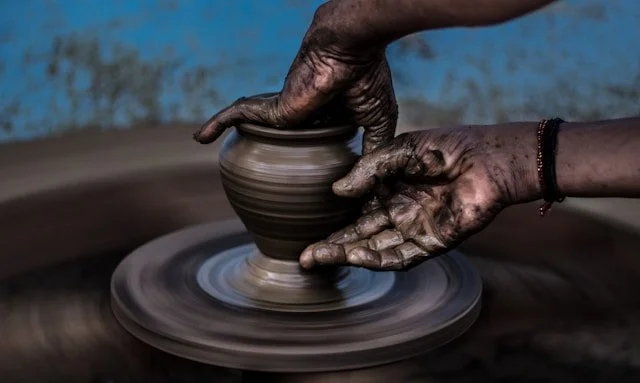
Photo by SwapnIl Dwivedi on Unsplash